

Perplexity AI is rapidly becoming one of the most powerful AI search and research tools available today. But like any AI, your results depend entirely on how well you prompt it. A weak prompt gives you generic answers. A strong prompt gives you cited, research-level responses in seconds.
Whether you’re a student, researcher, marketer, or content creator — knowing the right Perplexity AI prompts can completely transform your workflow. In this guide, you’ll find real, tested prompt examples across different use cases, so you can get the most out of Perplexity AI starting today.
How Perplexity AI Prompts Examples Work in 2026
Most people open Perplexity AI, type a quick question, and wonder why the answer feels shallow. The problem is rarely the tool. It is the prompt.
Perplexity has come a long way by 2026. It pulls from live web sources, recent research, and trusted publications in real time. Unlike traditional search engines, it does not just return links. It reads, processes, and summarizes information, then cites exactly where it came from.
But here is what separates casual users from power users. Prompt structure.
Think of it like talking to a very knowledgeable colleague. If you say “tell me about marketing” you will get a generic overview. But if you say “I run a small e-commerce store, what marketing channels worked best for similar businesses in 2025” now you are having a real conversation.
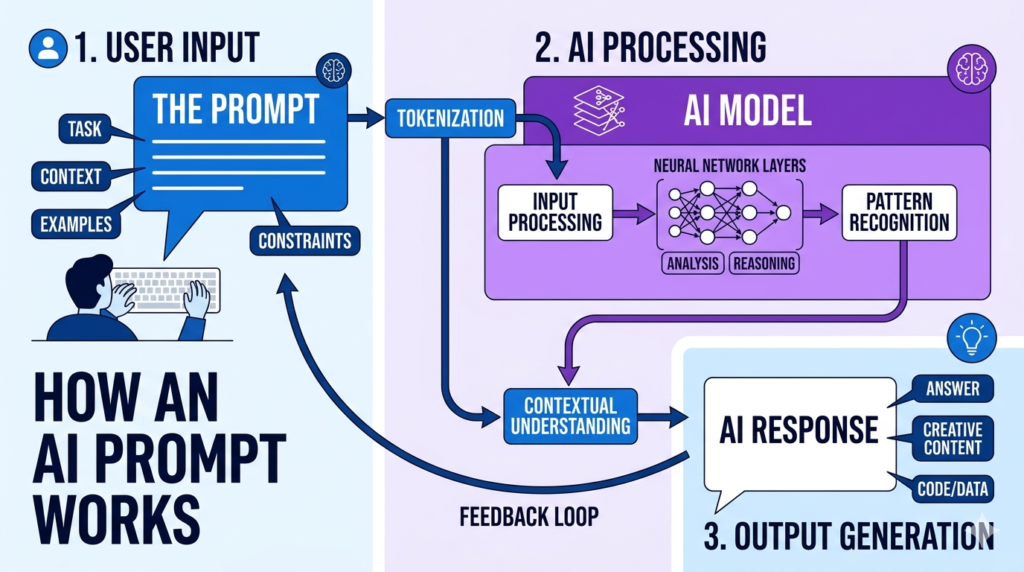
Here is how it works in plain terms:
- Input — You write a prompt with a clear goal, role, or format instruction
- Processing — Perplexity searches live web sources, academic papers, and trusted databases
- Output — You get a structured, cited, accurate answer, not hallucinated content
The Evolution of AI Prompts: From Basics to Perplexity
Not long ago, talking to an AI felt like filling out a government form. You typed something in. It spat something back. No context. No depth. No real understanding of what you actually needed.
Early AI tools were impressive for their time, but they had one big limitation. They only worked well if you already knew exactly what to ask. Most people did not. So they got mediocre answers and blamed the technology.
Then things started shifting.
ChatGPT showed the world that AI could hold a conversation. Suddenly prompting became a skill people actually wanted to learn. Writers, marketers, developers, researchers, everyone started experimenting with how to phrase things better.
But Perplexity AI took a different direction entirely.
Instead of just generating text from training data, it went out and searched the live web. Real sources. Real citations. Real answers based on what is actually happening right now, not what the model memorized two years ago.
That changed everything about how prompts needed to be written.
With Perplexity, a good prompt does not just get you a response. It gets you researched, sourced, trustworthy information that you can actually use and reference.
And that is what makes learning Perplexity AI prompt examples so valuable in 2026. You are not just learning how to talk to a chatbot. You are learning how to conduct real research, faster than ever before.
Crafting Effective Perplexity AI Prompts
Marketing
Whether you run ads, manage social media, write copy, or handle SEO — these prompts will save you hours of research and give you real, cited, actionable answers straight from Perplexity AI.
Brand Strategy
- “What brand positioning strategies are working best for small e-commerce businesses in 2026?”
- “Analyze the brand voice of [competitor name] and tell me what makes it effective.”
- “What are the biggest brand mistakes new businesses make in their first year?”
Content Marketing
- “Give me 10 blog post ideas for a [niche] business targeting [audience] in 2026.”
- “What content formats are getting the most organic traffic in [industry] right now?”
- “How do I build a content calendar for a one-person marketing team on a tight budget?”
Social Media Marketing
- “What posting frequency works best on Instagram for a product-based business in 2026?”
- “Write me a 30-day Instagram content plan for a fabric wholesale business targeting retailers.”
- “What type of reels are getting the most reach for small businesses right now?”
- “How do I grow a Facebook page organically for a local business with zero ad budget?”
SEO and Keyword Research
- “Find me low competition keywords for a blog targeting [niche] audience in 2026.”
- “What are the most common on-page SEO mistakes that kill rankings for new blogs?”
- “How do I do competitor keyword research using only free tools?”
- “What is the best internal linking strategy for a blog with under 50 articles?”
- “Explain E-E-A-T in simple terms and how a small blog can improve it fast.”
Email Marketing
- “Write me a 5-email welcome sequence for a new subscriber joining a digital marketing newsletter.”
- “What email subject lines get the highest open rates in the e-commerce space right now?”
- “How do I re-engage cold email subscribers without losing them permanently?”
- “What is the ideal email sending frequency for a small business audience?”
- “Give me 10 email newsletter ideas for a marketing agency targeting local businesses.”
Paid Advertising
- “What Meta Ads targeting strategy works best for a wholesale fabric business in Pakistan?”
- “How do I structure a Facebook ad campaign for a product launch with a small budget?”
- “What are the most common reasons Meta Ads get disapproved in 2026?”
- “Write me ad copy for a WhatsApp-based business selling wholesale fabrics to retailers.”
- “What is the best bidding strategy for a Facebook campaign focused on lead generation?”
Market Research
- “What are the biggest marketing trends in Pakistan’s e-commerce space in 2026?”
- “Who is the target audience for a premium fabric brand and what do they care about most?”
- “How do I research my competitors marketing strategy without spending any money?”
- “What consumer behavior shifts happened in South Asian markets over the last two years?”
- “Give me a full competitor analysis framework I can use for a local business in my niche.”
Research
People underestimate Perplexity AI as a research tool. Most just type a basic question and move on. But when you give it a well structured prompt, it goes deep. Real sources, real citations, real answers you can actually trust and use.
Academic Research
- “I am writing an essay on climate change impact on agriculture. Find me three recent studies published after 2023 with direct citations and summarize each one in simple language.”
- “Explain quantum computing to me like I have a basic science background, then give me two credible sources I can read to go deeper.”
- “What are researchers currently disagreeing about in the field of artificial intelligence ethics? Give me both sides with sources.”
- “Find me the most referenced academic paper on social media addiction published in the last three years and break down its key findings.”
- “I need to write a literature review on remote work productivity. Summarize what the most credible studies say and highlight where they contradict each other.”
Market Research
- “I sell handmade products online. Who is actually buying handmade goods in 2026, what do they care about, and where are they spending time online? Use recent data.”
- “What are customers in the fabric wholesale industry complaining about most right now? Pull from recent reviews, forums, and industry discussions.”
- “Give me the current market size of the AI tools industry and realistic growth projections for the next three years, with your sources listed.”
- “I want to understand my competitor. Analyze what [brand name] is doing well in their marketing and where they are leaving gaps I can fill.”
- “What pricing models are winning in the digital marketing agency space in 2026 and why are clients responding to them?”

Fact Checking
- “I keep seeing this stat shared everywhere: [paste stat]. Find the original source and tell me if it is still accurate or outdated.”
- “Someone told me [paste claim]. Is this actually true? Find credible sources that either back it up or prove it wrong.”
- “Check this paragraph for outdated information and tell me what needs updating with newer sources: [paste text].”
Trend Research
- “What is actually happening in the SEO industry right now that most blog posts are not covering yet? Find me fresh angles.”
- “How has consumer behavior in South Asian e-commerce markets shifted between 2023 and 2026? Give me data backed answers.”
- “What topics in the AI tools space are blowing up right now but still have very little quality content written about them?”
- “Walk me through the biggest changes in Meta advertising over the last 18 months and what marketers are doing differently because of them.”
Competitive Research
- “What content is sitting on page one for the keyword [your keyword] right now and what are those articles doing that makes Google trust them?”
- “Find me questions people are actively asking about [your topic] on Reddit, Quora, and forums that nobody has written a proper article about yet.”
- “I write a blog in the [niche] space. What content gaps exist that my competitors are completely ignoring right now?”
Writing
Blog Writing
- “My intro feels boring. Here it is: [paste it]. Rewrite it so someone actually wants to keep reading.”
- “Give me 7 headline ideas for an article about [topic]. Specific, clear, no clickbait.”
- “I am stuck on my blog post about [topic]. Here is what I have: [paste]. Tell me what is missing and how to finish it.”
- “My last five blog posts got no traffic. Here are the titles: [paste them]. What went wrong?”
Content and Niche
- “I write about [niche]. What content am I probably missing that my readers actually need?”
- “Write a comparison outline for [tool A] vs [tool B] that actually helps someone decide, not just list features.”
- “Here are three headline options I wrote: [paste them]. Which one would you click and why?”
Editing and Rewriting
- “Read this paragraph and tell me if it sounds human or robotic. Then fix it: [paste text].”
- “Make this section shorter and easier to read without losing the point: [paste section].”
- “Here are two of my blog intros: [paste them]. What writing habit am I stuck in and how do I fix it?”
- “Read these three paragraphs from my blog: [paste them]. Describe my natural writing voice in simple terms.”
Storytelling and Hooks
- “Write me an opening story for an article about [topic] that pulls the reader in from line one.”
- “Explain [topic] like you are talking to a complete beginner. Simple words, real examples.”
- “Write me a closing paragraph for an article about [topic] that leaves the reader feeling like it was worth their time.”
Copywriting
- “This product description is not converting. Rewrite it around the buyer’s problem, not the product features: [paste it].”
- “Write three call to action variations for [offer]. One casual, one direct, one urgent.”
- “Here is my about page: [paste it]. Rewrite it so it sounds like a real person, not a company brochure.”
- “Write me a cold pitch email for [service] targeting [client type]. Short, human, no corporate language.”
Social and Email
- “Turn this blog post into a LinkedIn post that feels native to the platform: [paste post or summary].”
- “Give me five newsletter subject lines for [topic] that make people want to open the email.”
Top 10 Perplexity AI Prompts Examples for Content Creation
1. Find Your Next Blog Topic
“I write about [niche] and my last post was about [topic]. What should I write about next that my audience actually needs right now?”
2. Build a Full Article Outline
“Give me a detailed outline for a blog post targeting the keyword [keyword]. Include H2s, H3s and a one line description of what each section should cover.”
3. Research Before You Write
“Before I write about [topic], what are the most important things I need to know? Pull from recent sources and give me citations.”
4. Fix Weak Writing
“This section of my article feels flat and boring: [paste it]. Rewrite it so it is engaging, clear and actually worth reading.”
5. Generate Real Examples
“I am writing about [topic] and need three real world examples that make the concept easy to understand for a beginner.”
6. Write for a Specific Audience
“Rewrite this paragraph for a [specific audience, e.g. small business owner in Pakistan] who has no technical background: [paste paragraph].”
7. Repurpose Your Content
“Here is a blog post I wrote about [topic]: [paste or summarize it]. Turn it into a Twitter thread, a LinkedIn post and a short email newsletter.”
8. Strengthen Your Conclusion
“Here is my article conclusion: [paste it]. It feels weak. Rewrite it so the reader walks away feeling like they learned something genuinely useful.”
9. Check Your Content Gaps
“I just wrote an article about [topic]. Here it is: [paste it]. What important points did I miss that a competing article might cover?”
10. Write a Meta Description
“Write me a meta description for an article titled [your title]. Keep it under 155 characters, include the keyword [keyword] and make it compelling enough to get the click.”
Common Mistakes When Using Perplexity AI Prompts
Being Too Vague
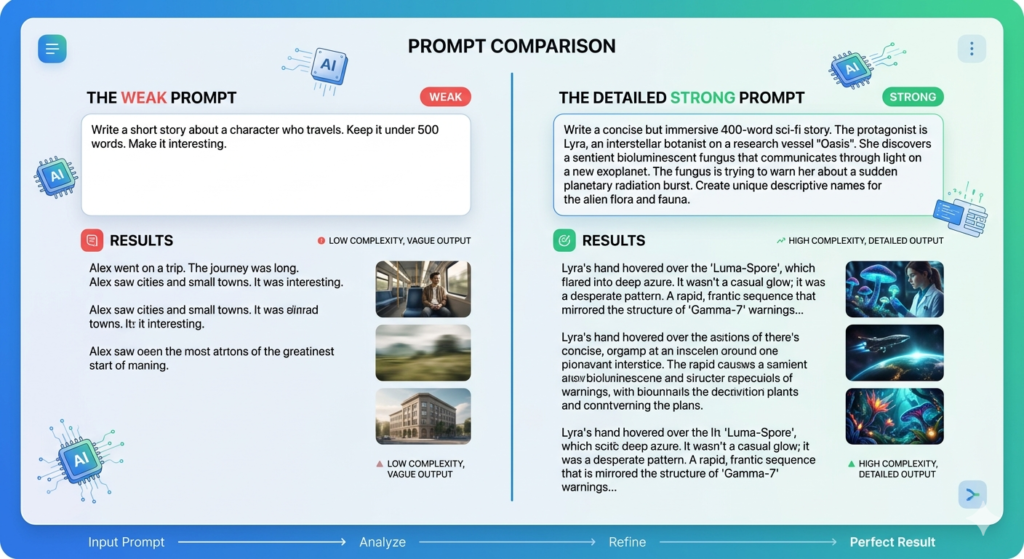
- Typing one word or one line questions and expecting detailed answers
- Not giving Perplexity any context about who you are or what you actually need
- Asking broad questions like “tell me about marketing” instead of something specific and focused
Not Using Context
- Forgetting to mention your niche, audience, or goal before asking anything
- Jumping straight into the question without setting up the situation first
- Expecting Perplexity to guess what you mean instead of telling it clearly
Ignoring Follow Up
- Treating every prompt like a one time transaction instead of a conversation
- Not asking follow up questions when the first answer feels incomplete
- Accepting the first response even when it clearly needs more depth
Copying Answers Without Checking
- Publishing Perplexity outputs without reading the cited sources yourself
- Trusting every statistic without verifying where it actually came from
- Using AI generated text directly without editing it into your own voice
Wrong Prompt Structure
- Writing prompts that are too long, too confusing, or have multiple unrelated questions in one
- Not telling Perplexity what format you want the answer in
- Asking it to do five things at once instead of breaking it into separate focused prompts
Underusing Its Search Ability
- Using Perplexity like a basic chatbot instead of a live research tool
- Not asking it to pull from recent sources when your topic needs current data
- Missing the opportunity to ask for citations that back up every claim
The Last Words
Getting good at Perplexity AI prompts is not something that happens overnight. It takes a little practice, a little patience, and a willingness to experiment until you find what works for your specific needs.
But here is the thing. You do not need to be a tech expert or a professional researcher to use it well. You just need to communicate clearly, give it context, and ask specific questions.
The prompts in this guide are your starting point. Take them, tweak them, make them your own. The more you use them, the more natural it becomes.
Perplexity AI is genuinely one of the most powerful free research tools available right now. The only question is whether you are going to use it properly or not.
The best way is to be specific about what you need. Mention your topic, your audience, and the format you want the answer in. Instead of asking “tell me about SEO” try asking “what are the most effective SEO strategies for a new blog in 2026 targeting a beginner audience.” The more context you give, the better your results will be.
Absolutely. Perplexity AI is not just a research tool. You can use it to build outlines, fix weak sections, generate real world examples, write meta descriptions, and even repurpose existing content into different formats. The prompts in this guide cover all of that in detail.
The most common reason is being too vague. If your prompt lacks context, a clear goal, or a specific format request, Perplexity has nothing solid to work with and gives you a generic answer. Go back to your prompt, add more detail about who you are, what you need, and what format works best for you. That one change alone makes a massive difference.