Moore Threads partners with Lightwheel Intelligence: Establishing a data link for domestic simulation synthesis and jointly building an embodied intelligent simulation foundation
Recently, Moore’s Threads and Lightwheel Intelligence have reached a strategic cooperation agreement. The two parties will rely on Moore Threads’ full-featured GPU and the KUAE intelligent computing cluster, combined with Lightwheel Intelligence’s self-developed simulation platform that integrates “solution-measurement-generation” into a three-in-one full stack, to jointly create a high-confidence simulation data synthesis solution. By deeply integrating domestic computing power with simulation algorithms, they will solidify an independent and controllable infrastructure for the development of embodied intelligence.
This collaboration directly addresses the core pain points of the embodied intelligence industry: real-device data acquisition has long faced challenges such as scarce physical data, high costs, insufficient scene coverage, and difficulty in reproducing complex physical processes stably. To bridge the data gap, high-quality simulated synthetic data has become a key path, but its large-scale production faces the computational bottleneck of an exponentially increasing rendering volume.
Taking a typical operational task as an example, a single…trajectory After generalization, the rendering volume can reach 48,000 frames (as shown in Figure 2), and hundreds of trajectories can reach the scale of millions of frames, which is difficult for traditional computing power to support. Such massive concurrent rendering and complex physical simulation tasks place rigid demands on the full-featured capabilities of GPUs, including AI computing, graphics rendering, and physical simulation. Hardware-level ray tracing is also the key to ensuring the physical realism of the synthesized data.
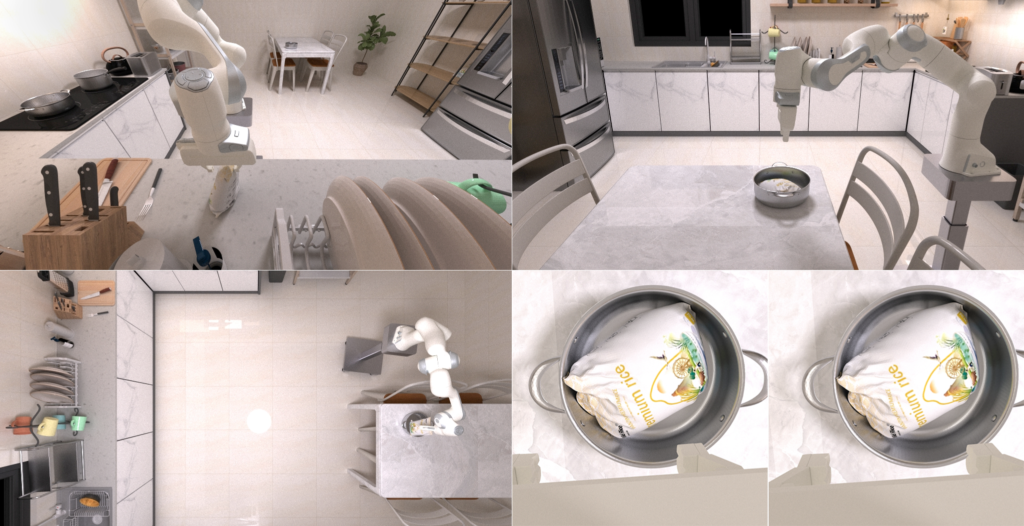
Figure 1: Example of synthetic data. The execution trajectory of a robotic arm task includes the rendering of images from 5 vision camera positions, which are use to generate visual simulation data for the robot.
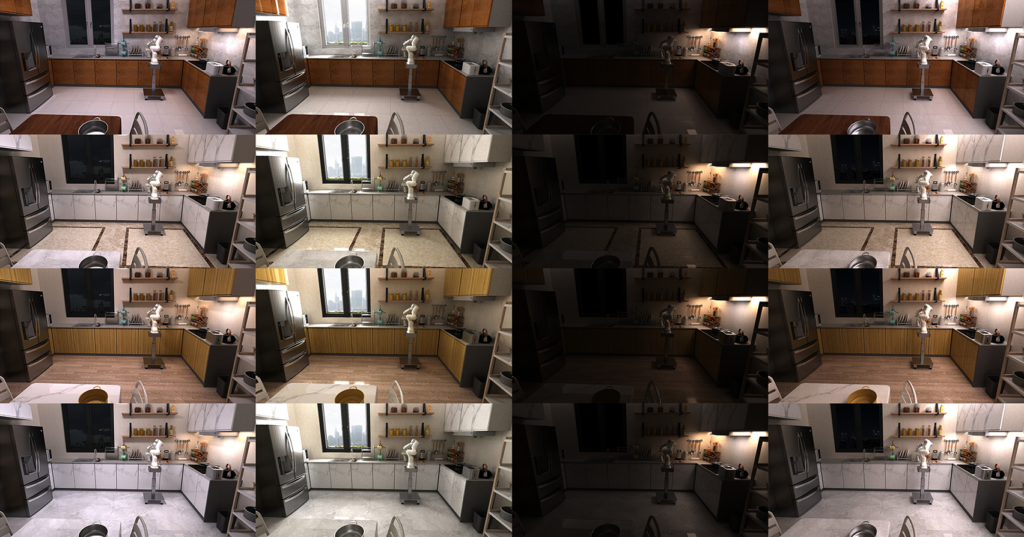
Figure 2: Four interior design styles and four lighting environments resulted in 16 sets of renderings. Each set of renderings involved five camera positions, with each camera position producing 600 frames. Ultimately, the total number of frames rendered for a single trajectory reached 48,000.
Domestic computing power combined with simulation algorithms to build an embodied intelligent synthetic data platform
To systematically address the aforementioned challenges, Moore Threads and Lightwheel Intelligence fully leveraged their respective strengths, and through deep collaboration between domestically produced GPU computing power bases and self-developed simulation synthesis technology, jointly constructed a complete domestic closed loop of “real trajectory → simulation modeling → data augmentation.” This not only overcame technical difficulties such as physical simulation of flexible body grasping but also made the large-scale “mass production” of massive, high-confidence synthetic data a reality.
As a leading global enterprise in physical AI data and simulation infrastructure, Lightwheel Intelligence pioneered a three-in-one full-stack self-developed simulation platform integrating “solution-measurement-generation,” providing core algorithms and simulation asset support for this collaboration.
In the simulation layer, Lightwheel’s self-developed high-precision GPU physics solver features differentiability, multi-physics, and multi-material unified solving. It supports high-precision real-time simulation of complex physical processes such as rigid bodies, soft bodies, fluids, and particles and is adapted to the Moore’s Threads MUSA architecture. On the MTT S5000 intelligent computing card, it leverages full-featured GPU native acceleration and ray tracing hardware units to achieve efficient and stable operation and high-fidelity rendering. Simultaneously, Lightwheel utilizes its pioneering physical measurement factory and virtual-real benchmarking methodology to introduce key physical parameters from the real world, such as mass, friction, contact, and deformation, into the simulation environment. Combined with the SimReady standard system, this ensures that simulation assets are verifiable, reusable, and scalable. The core physical parameter simulation accuracy reaches over 99%, providing a physically realistic foundation for the production of high-confidence synthetic data.
At the platform layer, a closed loop is built covering scene construction, task generation, simulation execution, and evaluation verification, forming a systematic evaluation capability represented by RoboFinals. Combined with Moore Threads’ domestic GPU computing power base and large-scale concurrency capabilities, it achieves efficient generalization of dimensions such as pose, physical properties, viewpoint, and environmental conditions and promotes embodied data from limited collection to large-scale generation.

Figure 3: Simulated robotic arm grasping flexible objects of different masses (the masses of the grasped objects increase from left to right).
Moore Threads fully leverages the advantages of a full-featured GPU computing platform. Based on its self-developed MUSA architecture, its single chip achieves a technological breakthrough by simultaneously supporting AI computing, graphics rendering, physics simulation, scientific computing, and ultra-high-definition video encoding and decoding, providing integrated, end-to-end computing power support for personalized intelligent synthetic data production. The flagship AI training and push-integrated intelligent computing card, MTT S5000, is one of the very few domestically produced GPUs that simultaneously supports hardware-level ray tracing and AI training and push, and it features a built-in independent ray tracing hardware unit (RT). Core: This system supports real-time, high-fidelity rendering of complex physical scenes. Based on the MTT S5000, the Kua’e 1000-card intelligent computing cluster, with its full-precision general-purpose computing capabilities, provides stable and efficient computing power for the production of massive synthetic data.
It supports efficient generalization across dimensions such as pose, physical properties, viewpoint, and environmental conditions in a single task, driving embodied data from limited acquisition to large-scale generation. Simultaneously, Moore’s Threads’ full-featured GPU supports Lightwheel’s self-developed physics solver, enabling complex physical calculations such as flexible body dynamics, rigid body collisions, and fluid simulations, ensuring that the synthetic data achieves industrial-grade physical consistency. accuracy required.
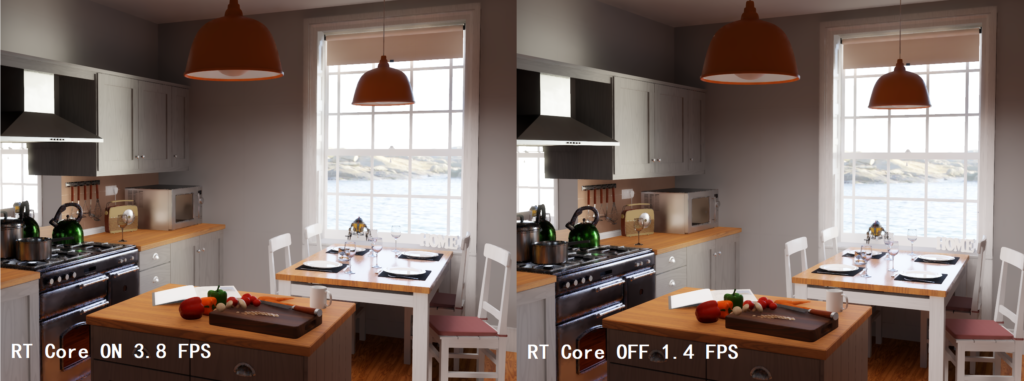
Figure 4: Using the MTT S5000 RT Core hardware ray tracing acceleration rendering can achieve a 2.7x performance improvement.
The domestically developed closed-loop system for embodied data generation, jointly built by both parties, demonstrates both Lightwheel Intelligence’s deep expertise in data and simulation and the full-stack computing capabilities of Moore’s Threads’ full-featured GPUs, significantly improving data synthesis and production efficiency. This practice signifies that Moore’s Threads and Lightwheel Intelligence are working together to create an “embodied intelligence data production infrastructure,” supporting the massive data demands of embodied intelligence and robot training with domestically developed technologies.
Building a Domestic Physical AI Foundation: Leading the Embodied Intelligence Ecosystem Towards Self-Reliance and Control
This collaboration is not only a powerful alliance of technologies but also signifies that China’s embodied intelligence infrastructure capabilities are moving from single-point breakthroughs to deeper collaborative construction. Both parties verified the deep compatibility between domestically developed physics solvers and domestically produced full-featured GPU computing power bases, providing the industry with a replicable model for comprehensive collaborative research from algorithms to chips and offering the embodied intelligence industry a full-stack value proposition encompassing computing power, algorithms, and data.
In the future, both parties will continue to deepen their cooperation in areas such as embodied intelligent assessment platforms and physics AI. Further exploration will be conducted in areas such as high-confidence closed-loop simulation, promoting cooperation from the current data synthesis stage to a full-platform closed loop of “simulation – training – evaluation,” continuously strengthening the independent and controllable domestic physical AI infrastructure, and accelerating the AI process of moving towards the physical world.