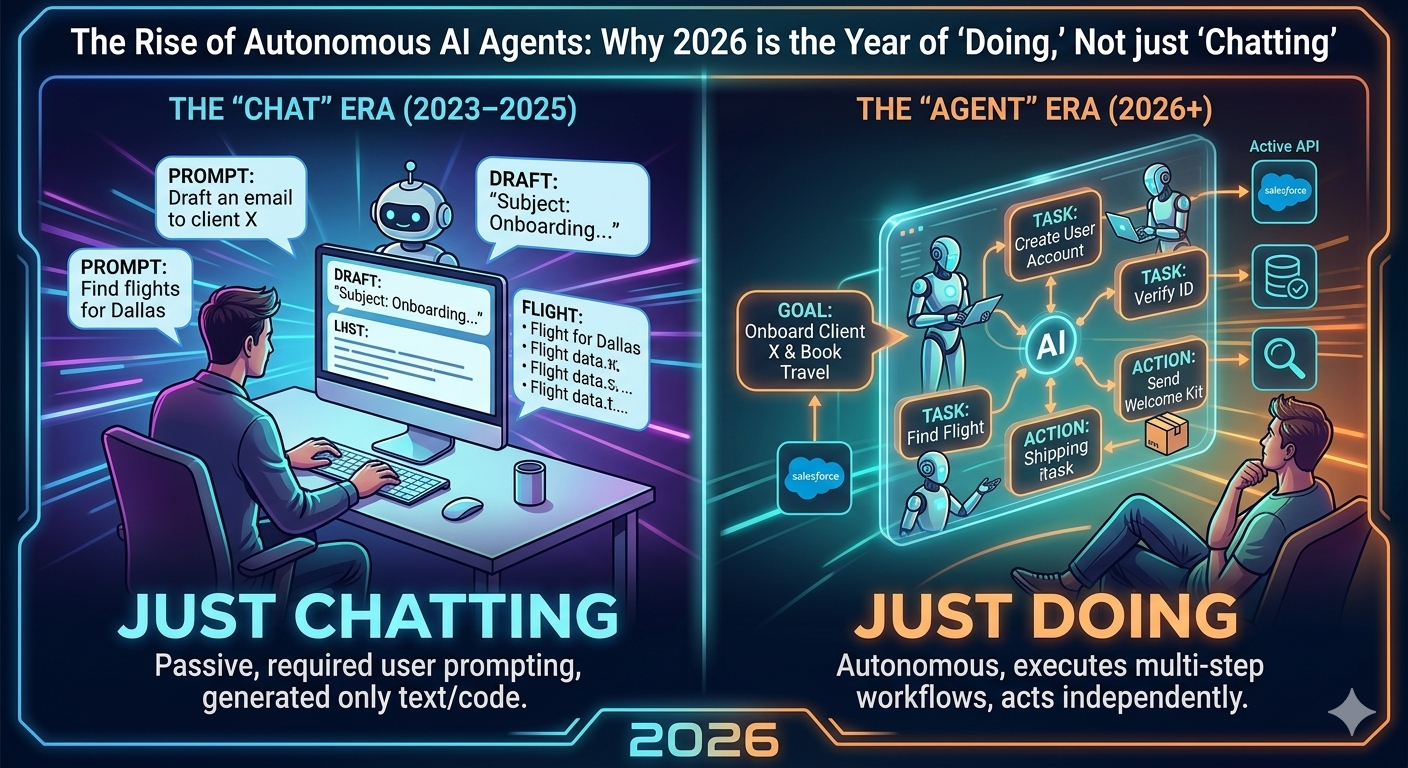

The artificial intelligence landscape has shifted dramatically. If 2023 was the year of the “chatbot” and 2024 was the year of “multimodality,” then 2026 is officially the year of the AI agent. For the past few years, we have been fascinated by the ability of large language models (LLMs) like ChatGPT, Claude, and Gemini to answer questions. However, we are now entering a phase where AI no longer just talks to us—it acts for us. This transition from passive assistants to autonomous agents is the most significant technological leap since the invention of the smartphone.
1. Defining the Shift: Chatbots vs. AI Agents
To understand where we are going, we must understand what we are leaving behind. A chatbot is reactive. You give it a prompt, and it gives you a text-based response. It lives within a “walled garden.”
An AI agent, on the other hand, is proactive and goal-oriented. It possesses agency. When you give an agent a goal—such as “Organize a 3-day business trip to Tokyo under a $2,000 budget”—it doesn’t just give you a list of hotels. It opens your browser, checks flight prices, compares hotel locations near your meeting venue, drafts emails to your colleagues, and adds the final itinerary to your calendar.
The Anatomy of an AI Agent:
- Perception: The ability to “see” your screen or access web data in real-time.
- Reasoning (Brain): Using models like DeepSeek-R1 or GPT-4o to plan steps.
- Tools (Hands): The ability to use APIs, click buttons, and execute code.
- Memory: Remembering your preferences (e.g., “I prefer aisle seats” or “I use Python for backend tasks”).
2. The Tech News: Native Integration in Windows and macOS
The biggest news driving this trend in early 2026 is the deep integration of AI agents into operating systems. Microsoft’s latest update to Windows 12 and Apple’s macOS Sequoia 2 have introduced “System-Wide Agency.”
This means the AI is no longer an app you open; it is a layer over your entire computer. You can now highlight a complex data set in Excel and tell the OS, “Clean this data, create a pivot table, and Slack the summary to the marketing team.” The AI executes these cross-app tasks without you ever having to switch windows.
3. Essential Tools for the Agentic Era
If you want to stay ahead of the curve, you need to move beyond simple prompting. Here are the top tools currently dominating the “Tools & Guides” category in 2026:
A. Manus AI: The Generalist Operator
Manus has become the “Gold Standard” for browser-based tasks. It uses a “Computer Use” framework that allows it to navigate websites exactly like a human would. It is currently being used for everything from automated stock market research to managing e-commerce returns.
B. AutoDev & Cursor: The Developer’s Best Friend
In the world of coding, agents have replaced basic auto-complete. Tools like Cursor now feature “Agentic Mode,” where the AI can look at an entire codebase, identify a bug across three different files, write the fix, run the tests, and submit a pull request—all while the developer grabs a coffee.
C. AgentGPT and BabyAGI (Evolution)
The open-source community has evolved these early projects into sophisticated frameworks. Developers are now using LangGraph and CrewAI to create “crews” of agents. Imagine having one agent as your “researcher,” one as your “writer,” and one as your “SEO specialist,” all working in a loop until the perfect article is produced.
4. Advanced AI Prompts for Agentic Workflows
To get the most out of these new tools, your prompting style must change. You are no longer asking for a “summary”; you are giving a “mission.”
The “Objective-Based” Framework:
Instead of saying, “Write a blog post about AI agents.” Try this Agentic Prompt:
“Objective: Create a high-ranking blog post.
- Research the top 5 trending keywords for ‘AI Agents’ using the web tool.
- Analyze the top 3 ranking articles on Google.
- Write a 1,000-word draft that fills the ‘content gaps’ identified.
- Format the output in Markdown and suggest 3 internal links to our ‘Tools’ category.”
5. The Economic Impact: Productivity or Replacement?
As these tools become more powerful, a common question arises: Will AI agents replace jobs?
The reality in 2026 is nuanced. Agents are not replacing “roles,” but they are replacing “tasks.” A digital marketer who spent 4 hours a day on data entry and report generation can now do that in 5 minutes using an agent. This allows the human to focus on high-level strategy and creativity—things AI still struggles with.
However, the barrier to entry for starting a business has vanished. A single individual can now run a “One-Person Unicorn” company by managing a fleet of AI agents that handle customer service, social media, and technical maintenance.
6. Challenges: Privacy and the “Hallucination Loop”
Despite the excitement, we must address the risks. Giving an AI agent access to your browser and bank account requires immense trust. Prompt injection attacks, where a malicious website could trick your agent into sending your private data to a third party, are the biggest cybersecurity threat of 2026.
Furthermore, if an agent makes a mistake in the middle of a multi-step process, it can lead to a “hallucination loop,” where it tries to fix a mistake with another mistake. Monitoring and “Human-in-the-loop” (HITL) verification remain essential.
7. Conclusion: How to Prepare for the Future
The era of the “Passive Web” is over. We are moving toward an “Actionable Web.” For website owners and tech enthusiasts, the advice is simple: Start experimenting now.
- Stop using AI for just text: Try tools that interact with your browser or code.
- Learn Workflow Design: Instead of learning how to write, learn how to architect a process.
- Stay Updated: Follow the “Tech News” category on our site to see which agents are gaining native OS support.
The future belongs not to those who can talk to AI, but to those who can manage AI agents to achieve complex goals.