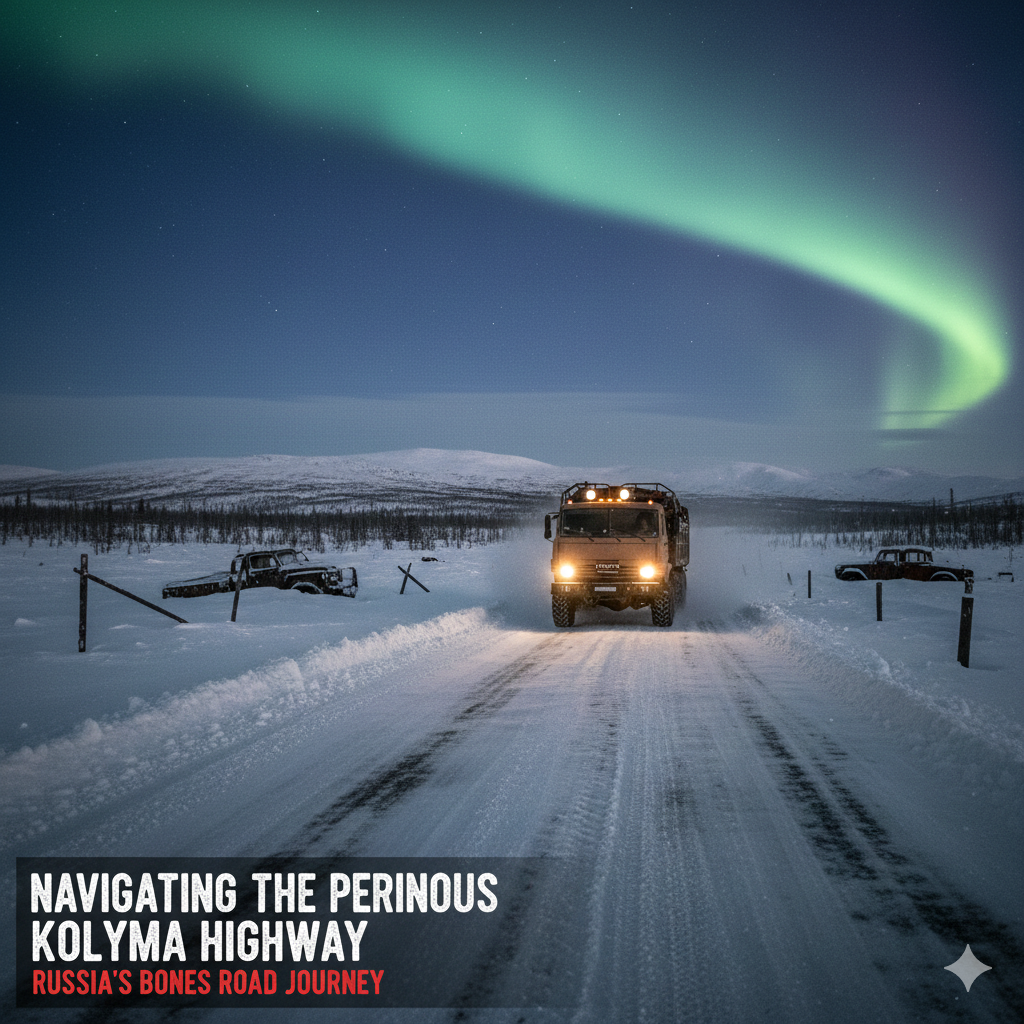

The Kolyma Highway offers an exhilarating journey from Yakutsk, where the coldest temperature ever recorded outside of Antarctica was measured, to Magadan, Russia. Constructed in the 1930s by inmates using hand tools, it represents one of the scariest periods in Soviet history.
Is it possible to drive the Road of Bones?
Part of the M56 route, the road lies tucked away on the edge of the world, via the Russian Far East, and is simply referred to locally as Kolymskaya trassa (“The Kolyma Route”) or Trassa (“The Route”). It is the only road in the area, so it doesn’t need a unique name. The only way to get to Nizhny Bestyakh (Yakutsk) is via this road. There isn’t an option. The road is unpaved and has little evidence of traffic. The region is essentially underdeveloped, lawless, little populated, and incredibly isolated. The general public has a negative opinion of this place. Convicts frequently associate Magadan with being one of the largest gulag distribution centers in the old USSR.
Is there no pavement on the Road of Bones?
R504 is the official name of the road. It’s quite challenging, largely unpaved, and full of tiny, jagged rocks. It’s not the best for a Sunday drive. There are numerous sand parts that begin abruptly after another corner, as well as several mud sections that are nearly impassable during rainy weather. The drive sheds light on the people who died during the Soviet Union’s worst moments and the sinister core of industrial Russia. Traveling alone in the region is a dangerous experience that carries a very real risk of death. The road was entirely abandoned when it was renovated in 2008, avoiding a 200-kilometer stretch between Tomtor and Kadykchan. This section of the road, also known as the Old Summer Road, now lies abandoned in the Siberian wilderness, complete with flooded roadways, destroyed bridges, and abandoned buildings.
What marks the start and finish of the Road of Bones?
The road is 1,868 km (1,160 miles) long and runs west-east from Magadan (the administrative center of Magadan Oblast, on the Sea of Okhotsk in Nagayev Bay) to Yakutsk (actually, Nizhny Bestyakh, in Megino-Kangalassky District of the Sakha Republic, on the eastern bank of the Lena River, where the coldest temperature ever recorded outside Antarctica was recorded). The largest city constructed on continuous permafrost, which is permanently frozen ground, is Nizhny Bestyakh. Due to the frozen ground, the majority of homes are constructed on concrete piles.
How long does the Road of Bones take to drive?
Most people will need four to five days to drive the road. This route offers plenty of fresh air, unmatched freedom, and breathtaking views. Long after we have left those locations, the sights will continue to evoke lovely recollections in our minds. The road traverses mountains, deserts, forests, and everything in between.
Does the Road of Bones pose a threat?
When it rains, the road’s normal clay coating changes into an insurmountable layer of mud that swallows both trucks and tractors, making it highly dangerous. Due to damaged bridges and sections of the road that have been reclaimed by streams, the route is in poor condition and impassable for regular cars. Extreme temperatures, a lot of snow and ice, poor visibility, too much mud in the summer that makes driving nearly impossible, and “Mud Pirates” are the main obstacles on the road.
Few travelers are aware of the world’s most frozen road—or its tragic past—making it one of the most dismal. Because of its surface, it is only possible to visit here in the dry summer months or in the winter months when it freezes and becomes covered in ice. It is nearly impassable and entirely covered in mud during other seasons. Due to the heavy snow, ice, and drastically decreased visibility, this route is exceedingly perilous during the ten-month winter.
However, the road’s conditions worsen over the summer. Mud poses the greatest threat in July and August. The absence of asphalt due to permafrost creates a traffic bottleneck from mud whenever the region experiences summer showers. Chaos ensues, immobilizing the route and leaving automobiles stranded in queues for up to 100 kilometers. Driving it after the rain can take five hours rather than several days. The primary dangers on the road are car accidents caused by reckless driving, poor roads, poorly maintained cars, and big trucks that can produce massive dust clouds in dry weather, which can easily conceal an approaching car. In general, maps are outdated. Wildlife, like bears, can also be dangerous.
For what reason is it known as the Road of Bones?
The Road of Bones is the popular name for the road. The nickname reflects its sad past. Under the Dalstroy construction directorate, it was constructed by the hundreds of thousands of political prisoners who were sent to the area’s gulags during the Stalin era, which lasted from the 1930s to the 1950s. In 1932, the prisoners of the Sevvostlag work camp constructed the first stretch. Shovels and wheelbarrows were among the very basic tools used for the task. Gulag camp prisoners carried out the construction until 1953. Others perished in the harsh circumstances of the gulags, while many were slaughtered for not working hard enough.
Another killer was the cold:
The Kolyma is in the coldest inhabited region on Earth, with recorded lows of about -70°C. Many of the deceased were merely laid to rest beneath the foundations of the road. Every meter of road constructed on the Kolyma Highway is claimed to have cost one life. Circulating on it actually entails passing over a massive mass grave that contains thousands of bodies. The road is considered a memorial because it buried the bones of the estimated 250,000–1,000,000 persons who perished during construction. Even now, one can still see the remnants of that terrible time.